
 About Us


English
- 中文
- English
English
- 中文
- English
-
Closely track new trends in the industry
In depth analysis of technical knowledge

Water based multifunctional additive - wetting agent leveling principle
Time: 2025-02-05 11:56:36
Author: 赛菲(天津)新材料科技有限责任公司
Click:
Wetting agent, also known as wetting aid, is an auxiliary agent that can improve the wettability of liquid objects on solid surfaces. It mainly reduces the surface tension or interfacial tension of liquids, making it easier for liquids to spread or penetrate on solid surfaces, and wetting solid materials. In water-based coatings, wetting agents can improve the wetting of the substrate by the coating, avoid spots and poor wetting, enhance adhesion, and help the coating cover evenly.
Water based multifunctional additive - wetting agent
Wetting agent, also known as wetting aid, is an auxiliary agent that can improve the wettability of liquid objects on solid surfaces. It mainly reduces the surface tension or interfacial tension of liquids, making it easier for liquids to spread or penetrate on solid surfaces, and wetting solid materials. In water-based coatings, wetting agents can improve the wetting of the substrate by the coating, avoid spots and poor wetting, enhance adhesion, and help the coating cover evenly.


Related concepts
【Surface tension】
The surface of matter inherently has a specific surface tension, while the surface tension of liquids is our main focus. Usually, once a liquid system is formed, it has a certain surface tension, and wetting and leveling are mainly determined by the surface tension difference between the liquid surface and another substance surface, as well as the surface tension balance at the same interface. It is generally believed that only when the surface tension of a liquid is below 40 dynes/centimeter, can it effectively wet the surface of a substrate (such as metal, plastic, wood, paper, etc.); The surface tension of water based systems is often higher than 40 dynes/cm, so surfactants must be added to water-based systems to control the surface tension of the system below 40 dynes/cm in order to successfully coat the substrate surface with water-based mixtures.
【Static surface tension】
·Surface energy of a system in a stationary or low-speed motion state
·When using the maximum bubble method for measurement, it is generally considered that 1-2b/s is the static surface tension
·Static surface tension cannot fully describe the surface behavior during the construction process
relation equation
Ɣ ∝ (P/R)
ƔExpressing surface tension;PFor the pressure inside the bubble;RFor capillary radius;
【Dynamic surface tension】
Dynamic surface tension refers to the surface tension of a system in motion (i.e., with constantly changing specific surface area), which varies with changes in liquid surface area. Most surfactants can effectively reduce the static surface tension of the system, but the effect is greatly reduced or even ineffective when the system is in a state of intense motion, mainly due to the lower migration speed of such surfactants in the system. Only surfactants with faster migration speeds can instantly reach the newly formed liquid surface, reducing the surface tension of the system in a timely manner.
In many production processes today, such as printing, spraying, roller coating, grinding, etc., dynamic surface tension has become the main factor affecting production speed. The dynamic surface tension is low, and the coating can be quickly applied to the substrate surface, greatly improving the construction speed and thus enhancing production efficiency.
Dynamic surface tension can generally be measured using the maximum bubble method, which calculates the surface tension at that state based on the maximum pressure inside the bubble; Assuming that blowing one bubble into the system per second is static, as the frequency of bubble blowing increases, the motion state of the system becomes more intense. We use the surface tension at a system state of six bubbles per second to represent the dynamic surface tension.
Ke Tu Le ® Due to its unique dual factor molecular structure, additives determine their orientation in water-based systems, thereby achieving rapid migration ability and effectively controlling the dynamic surface tension of the system.
Characteristic
·Surface energy of the system in rapid motion state
·When using the maximum bubble method for measurement, it is generally considered that dynamic surface tension is above 4b/s
·Dynamic surface tension can describe the surface behavior during the construction process
Leveling principle
【The main model of wet film motion】
(1)Distribution flow on substrate - contact angle model:
When the sum of surface tension and interfacial tension of paint is higher than or not significantly different from the critical surface tension of the substrate, the paint is difficult to spread on the substrate, has poor wetting of the substrate, reduces paint adhesion, and is prone to shrinkage, forming 'shrinkage holes' or even 'bead formation'. Only when γ S>γ I+γ L can the liquid be fully spread

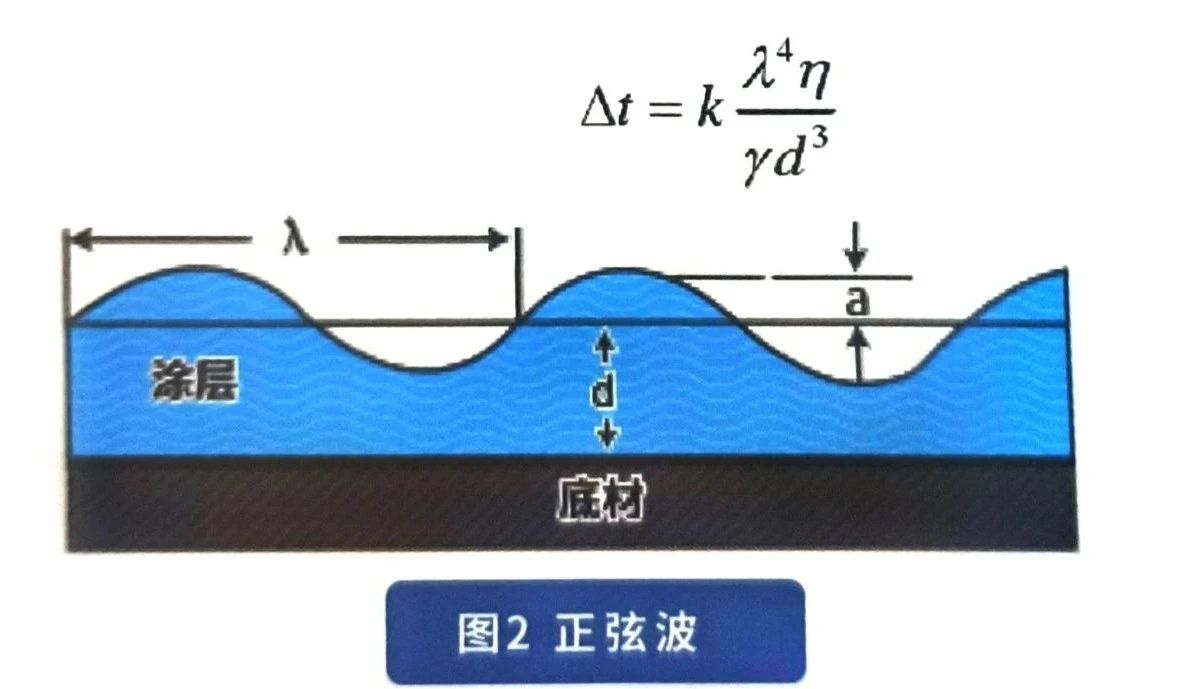
(2)Sine wave model of flow from uneven surface to flat surface;
The quality of coating leveling is related to many factors. According to Rhodes&Orch ä d's wet film flow equation based on sine wave model:
△t:The time required for the ripple state to level to a flat state
K:constant;
λ :The wavelength of a sine waveform; (Fourth power)
η:Viscosity of liquid;
γ: Surface tension of liquids;
d: Paint film thickness. (Third Power)
(3)The Bernard vortex in the vertical direction:
Due to the evaporation of solvents and the resin system itself, the difference in surface tension between the surface and inner layers of the coating during the drying process causes the internal flow of the coating to sink, rise, and disperse repeatedly until its viscosity increases enough to prevent its flow. At this point, the surface tension difference also tends to disappear

【Characteristics that leveling agents should possess】
·Reduce the surface tension between the coating and the substrate, so that the coating and substrate have good wettability and do not cause a gradient in surface tension between substances:
·Adjust solvent evaporation rate, reduce viscosity, improve coating flowability, and extend leveling time;
·Form an extremely thin monolayer on the surface of the coating to provide uniform surface tension;


点击右上角
分享给朋友吧







 Long by picture save/share
0
 TEL:022-29508668 022-84120378 186-2218-6875 133-8993-6728
 ADD:Building A4, Yinkun Future Huizhi Manufacturing Industrial Park, No. 15
Huaming Avenue,Dongli District, Tianjin
专注于功能添加剂研究与开发
以专业且诚挚的态度,为您提供定制化的服务,期待您的来电!

WeChat official account

Kwai official account

Tiktok official account
Copyright © 2025 All Rights Reserved Surfy (Tianjin) New Material Technology Co., Ltd. All rights reserved
Technical Support: Yunchuang Chengda This site supports IPv6
TEL:022-29508668 022-84120378
186-2218-6875 133-8993-6728
ADD:Building A4, Yinkun Future Huizhi Manufacturing Industrial Park, No. 15 Huaming Avenue, Dongli District, Tianjin
WeChat official account
WeChat official account
Tiktok official account
Copyright © 2025 All Rights Reserved Surfy (Tianjin) New Material Technology Co., Ltd.
Technical support:Yunchuang Chengda
This site supports IPv6
